
Emergency medications nurses must know are the drugs that make the biggest difference when seconds matter.
That’s why recognizing crash cart medications is more important than memorizing long drug lists.
You need to know what the medication is for. When it is used. And what to watch for after it is given.
In this guide, you’ll learn the essential emergency medications nurses must know, organized the way they are used in real clinical situations.
You’ll understand how these drugs support cardiac function, breathing, circulation, and survival during emergencies.
To check your baseline knowledge as you learn, you can practice here:
Emergency Drug Quiz.
What Is a Crash Cart and Why Nurses Must Be Ready
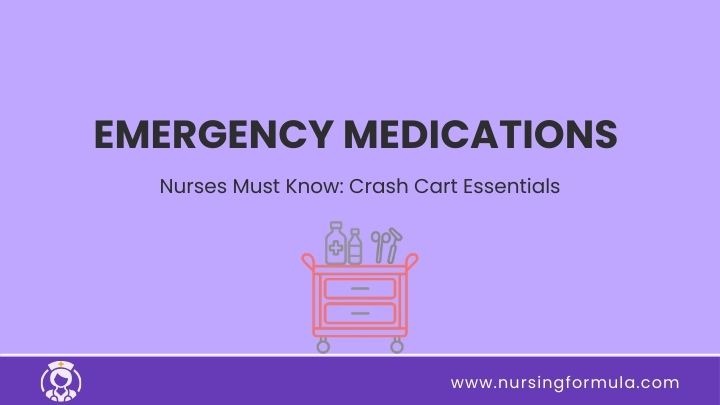
A crash cart is a mobile emergency supply station.
It contains life-saving medications, equipment, and supplies used during critical situations.
When a patient crashes, there is no time to search.
Everything must be ready.
And nurses must know where to reach.
What a Crash Cart Is Used For
Crash carts are used during life-threatening emergencies, including:
- Cardiac arrest
- Respiratory failure
- Severe anaphylaxis
- Unstable arrhythmias
- Rapid hemodynamic collapse
These situations require immediate action.
Delays in medication access can affect survival.
In many settings, the crash cart is brought to:
- Code blue events
- Rapid response calls
- ICU and emergency department emergencies
Nursing Tip: If you know what’s on the crash cart, you don’t waste time opening the wrong drawer.
Why Nurses Are Often the First to Act
In emergencies, nurses are usually at the bedside first.
You assess the patient.
You recognize the change.
You call for help.
While the team gathers, nurses often:
- Start CPR
- Apply oxygen
- Prepare emergency medications
- Assist with airway management
That means nurses must be familiar with crash cart medications before an emergency happens.
Example
A patient suddenly becomes unresponsive.
The nurse initiates a code and begins CPR.
While help arrives, the nurse prepares epinephrine from the crash cart.
Knowing where the medication is—and what it’s used for—saves critical seconds.
In emergencies, preparation turns panic into action.
How Emergency Medications Are Organized on a Crash Cart
Crash carts are designed for speed and clarity.
Every drawer has a purpose.
Every layout reduces confusion during high-stress moments.
Knowing the organization helps nurses act quickly without guessing.
Common Crash Cart Drawer Categories
While layouts vary by facility, most crash carts follow a similar structure.
| Drawer Category | What It Typically Contains | Why It Matters |
|---|---|---|
| Cardiac arrest meds | Epinephrine, amiodarone, adenosine | Immediate rhythm and perfusion support |
| Airway & respiratory meds | Albuterol, ipratropium, corticosteroids | Rapid airway and breathing support |
| Emergency IV meds | Dextrose, calcium gluconate, sodium bicarbonate | Metabolic and electrolyte emergencies |
| Reversal agents | Naloxone, flumazenil | Rapid reversal of drug effects |
| Supplies & syringes | Flushes, needles, labels | Safe preparation and administration |
Nursing Tip: Take time to review your unit’s crash cart layout before an emergency happens.
Why Organization Reduces Medication Errors
During a code, stress is high.
Noise increases.
Multiple people are giving instructions.
A well-organized crash cart helps by:
- Reducing time spent searching
- Preventing wrong-drug selection
- Supporting clear role assignment
When medications are grouped logically, nurses can anticipate what comes next.
Example
During a cardiac arrest:
- One nurse prepares epinephrine
- Another prepares amiodarone
- A third manages airway support
Because each medication is in a predictable location, the team moves efficiently.
When everyone knows where to look, fewer words are needed.
Labeling and Standardization on Crash Carts
Most crash carts use:
- Clear labels
- Color-coded drawers
- Sealed locks that show tampering
These features support safety and accountability.
Why Seals Matter
A broken seal tells staff:
- The cart has been opened
- Medications and supplies must be checked
This prevents missing items during emergencies.
Nursing Tip: Always check the crash cart seal during shift checks.
Quick Self-Check for Nurses
Ask yourself:
- Do I know where emergency medications are stored?
- Could I find epinephrine without looking twice?
- Do I know which drawer holds airway medications?
If the answer is no, take time to review the cart.
Preparation now prevents hesitation later.
Cardiac Arrest and Life-Threatening Dysrhythmia Medications
During a cardiac emergency, medications are given with a clear purpose.
Restore circulation.
Stabilize the rhythm.
Support perfusion.
Nurses must recognize these drugs quickly and understand when and why they are used.
Epinephrine
Epinephrine is the first-line medication during cardiac arrest.
It works by:
- Increasing vasoconstriction
- Improving coronary and cerebral perfusion
- Supporting return of spontaneous circulation (ROSC)
Common Emergency Uses
- Cardiac arrest (asystole, PEA, VF/VT per protocol)
- Severe bradycardia with hypotension (per order/protocol)
Example
A patient is in pulseless electrical activity (PEA).
CPR is in progress.
Epinephrine is administered according to protocol to improve perfusion during resuscitation.
Nursing Tip: Epinephrine supports circulation. CPR supports life. Both work together.
Amiodarone
Amiodarone is used for life-threatening ventricular dysrhythmias.
It helps by:
- Stabilizing the cardiac rhythm
- Reducing abnormal electrical activity
Common Emergency Uses
- Ventricular fibrillation (VF)
- Pulseless ventricular tachycardia (VT)
Example
A patient remains in ventricular fibrillation after defibrillation and epinephrine.
Amiodarone is prepared and administered as directed.
This medication is not first—it’s added when shockable rhythms persist.
Adenosine
Adenosine is used for specific tachyarrhythmias, not cardiac arrest.
It works by:
- Briefly slowing conduction through the AV node
- Helping reset certain supraventricular rhythms
Common Emergency Uses
- Stable supraventricular tachycardia (SVT)
Important Nursing Consideration
- Adenosine is given rapidly
- Patients may feel chest discomfort or flushing
- The pause in rhythm is expected and brief
Example
A patient presents with a narrow-complex tachycardia and is stable.
Adenosine is administered rapidly to interrupt the rhythm.
Nursing Tip: Always warn the patient before giving adenosine if time allows.
Cardiac Emergency Medications
| Medication | Primary Use | Key Nursing Focus |
|---|---|---|
| Epinephrine | Cardiac arrest | Timing, CPR coordination |
| Amiodarone | VF/VT | Rhythm monitoring |
| Adenosine | SVT | Rapid administration, patient response |
What Nurses Should Remember During Cardiac Emergencies
- Follow the emergency protocol
- Communicate clearly with the team
- Prepare medications promptly and accurately
- Monitor rhythm and patient response continuously
In cardiac emergencies, clarity and preparation save lives.
Respiratory and Airway Emergency Medications
When breathing is compromised, oxygen delivery becomes the priority.
Airway and respiratory medications on the crash cart help open airways, reduce inflammation, and prevent respiratory failure.
Nurses must recognize these medications quickly and know what problem each one treats.
Albuterol
Albuterol is a rapid-acting bronchodilator.
It works by:
- Relaxing bronchial smooth muscle
- Opening narrowed airways
- Improving airflow
Common Emergency Uses
- Acute asthma exacerbation
- Bronchospasm
- COPD flare
Example
A patient develops wheezing and shortness of breath after surgery.
Oxygen saturation is dropping.
Albuterol is administered to relieve bronchospasm and improve airflow.
Nursing Tip: Monitor heart rate—albuterol can cause tachycardia.
To reinforce respiratory medication recognition, practice here:
Respiratory Drugs Quiz.
Ipratropium
Ipratropium is an anticholinergic bronchodilator.
It is often used with albuterol for stronger bronchodilation.
It helps by:
- Reducing airway constriction
- Decreasing mucus production
Common Emergency Uses
- Moderate to severe asthma
- COPD exacerbations
Example
A patient with COPD presents with severe dyspnea.
Albuterol and ipratropium are given together to maximize airway opening.
Combination therapy often works better than one medication alone.
Corticosteroids (e.g., Dexamethasone)
Corticosteroids do not act instantly.
But they are critical for preventing delayed airway swelling.
They work by:
- Reducing inflammation
- Preventing worsening airway edema
Common Emergency Uses
- Severe asthma
- Anaphylaxis (adjunct therapy)
- Upper airway inflammation
Example
After initial treatment for anaphylaxis, dexamethasone is given to reduce delayed airway swelling.
Nursing Tip: Steroids support airway stability over time, not immediate relief.
Respiratory Emergency Medications
| Medication | Primary Action | When Nurses Use It |
|---|---|---|
| Albuterol | Rapid bronchodilation | Acute bronchospasm |
| Ipratropium | Sustained bronchodilation | Severe asthma/COPD |
| Dexamethasone | Anti-inflammatory | Prevents airway edema |
What Nurses Must Monitor After Respiratory Medications
After administration, monitor:
- Oxygen saturation
- Respiratory effort
- Lung sounds
- Heart rate
Early improvement is a good sign. Worsening distress requires escalation.
To practice emergency airway decision-making, review:
Emergency Drug Quiz.
Anaphylaxis and Severe Allergy Emergency Medications
Anaphylaxis is a life-threatening emergency.
Airways can swell.
Blood pressure can drop.
Symptoms can worsen within minutes.
Crash cart medications for anaphylaxis are used to stop the reaction, support breathing, and stabilize circulation.
Epinephrine for Anaphylaxis
Epinephrine is the first-line treatment for anaphylaxis.
It works by:
- Constricting blood vessels to raise blood pressure
- Relaxing bronchial smooth muscle to improve breathing
- Reducing airway swelling
Key Nursing Points
- IM administration is preferred in anaphylaxis
- Do not delay epinephrine while waiting for other medications
- Early administration improves outcomes
Example
A patient develops hives, wheezing, and hypotension after receiving an antibiotic.
Epinephrine is administered immediately to reverse airway swelling and support circulation.
Nursing Tip: In anaphylaxis, epinephrine first. Everything else supports it.
Diphenhydramine
Diphenhydramine is an antihistamine.
It does not replace epinephrine.
It helps by:
- Reducing itching and hives
- Blocking histamine effects
Common Emergency Uses
- Adjunct treatment in anaphylaxis
- Severe allergic reactions
Example
After epinephrine is given, diphenhydramine is administered to control persistent hives and itching.
Antihistamines treat symptoms. Epinephrine treats the emergency.
Famotidine
Famotidine is an H2 blocker.
It supports antihistamine therapy.
It helps by:
- Blocking additional histamine receptors
- Supporting symptom control
Role in Emergencies
- Adjunct therapy in severe allergic reactions
- Not used alone for anaphylaxis
Example
A patient with anaphylaxis receives epinephrine, diphenhydramine, and famotidine as part of a complete treatment plan.
Anaphylaxis Emergency Medications
| Medication | Primary Role | Priority Level |
|---|---|---|
| Epinephrine | Life-saving intervention | First-line |
| Diphenhydramine | Symptom relief | Adjunct |
| Famotidine | Histamine blockade support | Adjunct |
What Nurses Must Monitor After Anaphylaxis Treatment
After medication administration, monitor:
- Airway patency
- Oxygen saturation
- Blood pressure
- Recurrence of symptoms
Symptoms can return after initial improvement.
Nursing Tip: Anaphylaxis can be biphasic. Observation matters.
To strengthen high-risk medication awareness during emergencies, practice here:
High-Risk Drug Safety Quiz.
Reversal Agents Every Nurse Must Recognize
Reversal agents are used when a medication’s effects become dangerous.
They work quickly.
And they can save lives when used correctly.
Because these drugs can rapidly change a patient’s condition, nurses must recognize when they are appropriate and what to monitor after administration.
Naloxone
Naloxone is an opioid antagonist.
It reverses the effects of opioids on the central nervous system.
It works by:
- Displacing opioids from receptor sites
- Restoring respiratory drive
- Improving level of consciousness
Common Emergency Uses
- Opioid overdose
- Respiratory depression related to opioids
Example
A patient receiving opioid pain medication becomes unresponsive with slow respirations.
Naloxone is administered to reverse respiratory depression.
Nursing Tip: Naloxone reverses opioids, not sedation from other causes.
After naloxone, monitor closely.
Pain may return.
Withdrawal symptoms may occur.
To practice recognizing opioid-related emergencies, review:
Pain Medications Quiz.
Flumazenil
Flumazenil is a benzodiazepine antagonist.
It reverses the sedative effects of benzodiazepines.
It works by:
- Blocking benzodiazepine receptors
- Improving level of consciousness
Common Emergency Uses
- Benzodiazepine overdose (selected cases only)
Important Safety Considerations
- Not routinely used
- Can trigger seizures in patients with chronic benzodiazepine use
- Use only when benefits outweigh risks
Example
A patient becomes overly sedated after procedural benzodiazepines.
Flumazenil is administered cautiously under close monitoring.
Reversal is powerful. Use it carefully.
Common Reversal Agents
| Medication | Reverses | Key Nursing Consideration |
|---|---|---|
| Naloxone | Opioids | Monitor for re-sedation |
| Flumazenil | Benzodiazepines | Seizure risk |
What Nurses Must Monitor After Reversal Agents
After administering a reversal agent, assess:
- Respiratory status
- Level of consciousness
- Vital signs
- Return of symptoms
Reversal effects may wear off before the original drug does.
Nursing Tip: Reversal agents buy time. Ongoing monitoring protects the patient.
Electrolyte and Metabolic Emergency Medications
Electrolyte and metabolic imbalances can quickly become life-threatening.
They affect the heart, brain, and muscles.
Crash cart medications in this category help stabilize cells, correct dangerous levels, and prevent cardiac complications.
Nurses must recognize these medications and understand what problem they fix first.
Dextrose
Dextrose is used to treat acute hypoglycemia.
It works by:
- Rapidly increasing blood glucose
- Restoring brain function
- Preventing seizures and coma
Common Emergency Uses
- Symptomatic hypoglycemia
- Altered mental status with low blood glucose
Example
A patient becomes confused and diaphoretic.
Point-of-care glucose reads 38 mg/dL.
Dextrose is administered to quickly restore blood glucose.
Nursing Tip: Always recheck blood glucose after dextrose administration.
To practice recognizing glucose-related emergencies, review:
Endocrine Drugs Quiz
Calcium Gluconate
Calcium gluconate is used to protect the heart, not to lower potassium.
It works by:
- Stabilizing cardiac cell membranes
- Reducing the risk of lethal dysrhythmias
Common Emergency Uses
- Severe hyperkalemia
- Hypocalcemia with cardiac symptoms
Example
A patient with renal failure has peaked T waves on ECG.
Calcium gluconate is administered to stabilize the myocardium while other treatments lower potassium.
Calcium buys time. It does not fix the potassium level.
Sodium Bicarbonate
Sodium bicarbonate is used in specific metabolic emergencies.
It works by:
- Buffering excess acid
- Shifting potassium temporarily into cells
Common Emergency Uses
- Severe metabolic acidosis
- Selected cardiac arrest situations
- Certain drug overdoses
Example
A patient with prolonged cardiac arrest and severe acidosis receives sodium bicarbonate as part of advanced resuscitation.
Nursing Tip: Sodium bicarbonate is not routine. It is used selectively.
Electrolyte & Metabolic Emergency Medications
| Medication | Primary Emergency Use | Key Nursing Focus |
|---|---|---|
| Dextrose | Hypoglycemia | Recheck glucose |
| Calcium gluconate | Hyperkalemia | Cardiac monitoring |
| Sodium bicarbonate | Severe acidosis | ABGs, ECG |
What Nurses Must Monitor After Administration
After giving these medications, monitor:
- Cardiac rhythm
- Blood glucose levels
- Electrolyte trends
- Mental status
Correction can cause rapid physiologic changes.
Nursing Tip: Treat the emergency first. Address the cause next.
To strengthen electrolyte and metabolic emergency decision-making, practice here:
Fluid & Electrolyte Balance Quiz.
Shock and Hemodynamic Support Medications
Shock occurs when tissues do not receive enough oxygenated blood.
Blood pressure drops.
Organs suffer.
Emergency medications in this category help support circulation and restore perfusion until the underlying cause is treated.
Nurses must recognize these medications quickly and monitor patients closely after administration.
Norepinephrine
Norepinephrine is a first-line vasopressor for many types of shock.
It works by:
- Causing vasoconstriction
- Increasing systemic vascular resistance
- Raising blood pressure and improving perfusion
Common Emergency Uses
- Septic shock
- Cardiogenic shock
- Severe hypotension unresponsive to fluids
Example
A patient with sepsis remains hypotensive after fluid resuscitation.
Norepinephrine is started to support blood pressure and maintain organ perfusion.
Nursing Tip: Norepinephrine supports blood pressure. Fluids support volume. Both are often needed.
To reinforce pressor recognition and safe use, practice here:
Cardiac Drugs Quiz.
Dopamine
Dopamine may be used in selected shock situations, depending on patient factors and facility protocol.
It works by:
- Increasing heart rate
- Increasing cardiac output
- Raising blood pressure at higher doses
Common Emergency Uses
- Shock with bradycardia
- Selected hypotensive states
Example
A patient with symptomatic bradycardia and hypotension receives dopamine to support heart rate and blood pressure.
Dopamine affects both the heart and blood vessels.
Quick Comparison Table: Shock Medications
| Medication | Primary Effect | When Nurses See It Used |
|---|---|---|
| Norepinephrine | Vasoconstriction | Septic or cardiogenic shock |
| Dopamine | Increases HR and BP | Bradycardic shock |
What Nurses Must Monitor During Vasopressor Therapy
After starting or titrating these medications, monitor:
- Blood pressure trends
- Heart rate and rhythm
- Urine output
- Signs of adequate perfusion
Small changes in dose can cause large physiologic effects.
Nursing Tip: Pressors are never “set and forget.”
Nursing Responsibilities During Emergency Medication Administration
Emergency medications save lives.
But only when they are given correctly, quickly, and safely.
Even in high-stress situations, nurses play a central role in preventing errors and coordinating care.
Medication Verification Under Pressure
Emergency situations move fast.
Verification still matters.
Even during a code or rapid response, nurses remain responsible for safe medication checks.
Speed should never replace accuracy.
This is where the principles from The 10 Rights of Medication Administration apply most clearly.
They guide verification even when time is limited.
Before administering an emergency medication, nurses must confirm:
- The right medication
- The right dose
- The right route
This verification often happens verbally and visually at the same time.
Example
During a code, a provider calls out an order for epinephrine.
The nurse repeats the medication name and dose aloud while drawing it up.
Another team member visually confirms the syringe.
This double-check helps catch errors before the drug is given.
Nursing Tip: In emergencies, say it out loud and show it clearly.
To strengthen medication verification skills under pressure, practice here:
Drug Administration Techniques Quiz
Closed-Loop Communication During Emergencies
Closed-loop communication reduces confusion during codes.
It means:
- Orders are clearly stated
- Orders are repeated back
- Completion is confirmed
This keeps everyone on the same page.
Example
Provider: “Give epinephrine 1 mg IV.”
Nurse: “Epinephrine 1 mg IV, preparing now.”
Nurse after giving medication: “Epinephrine 1 mg IV administered.”
Clear words prevent unclear outcomes.
Monitoring Patient Response After Administration
Giving the medication is not the final step.
Monitoring is essential.
After emergency medications, nurses monitor:
- Vital signs
- Cardiac rhythm
- Oxygen saturation
- Level of consciousness
Response guides the next intervention.
Example
After administering a vasopressor, blood pressure improves but heart rate increases.
The nurse reports the change and continues close monitoring.
Nursing Tip: Watch trends, not just numbers.
Documentation After the Emergency
Once the situation stabilizes, documentation matters.
Emergency medication documentation should include:
- Medication name
- Dose
- Route
- Time given
- Patient response
This protects the patient and the nurse.
Example
A nurse documents the sequence of emergency medications given during a rapid response.
This record supports continuity of care and legal safety.
Nursing Tip: Document as soon as it is safe to do so.
To reinforce safe documentation and follow-up, practice here:
Medication Error Prevention Quiz
Common Emergency Medication Errors Nurses Must Avoid
Emergency situations increase pressure.
Pressure increases risk.
Most emergency medication errors follow predictable patterns.
Knowing them helps nurses stop errors before they reach the patient.
Dose and Route Confusion
Emergency medications are often given IV, IM, or rapidly pushed.
Confusion about dose or route can cause serious harm.
Common mistakes include:
- Giving an IM dose IV
- Confusing mg with mL
- Drawing up the wrong concentration
Example
Epinephrine for anaphylaxis is ordered IM.
IV epinephrine is mistakenly prepared instead.
That route error can cause severe hypertension or arrhythmias.
Nursing Tip: Always pause and confirm the route before administration.
Look-Alike / Sound-Alike Medication Errors
Many emergency medications have similar names or packaging.
These errors happen most often when:
- Nurses are rushed
- Medications are stored close together
- Labels are not read fully
Common LASA risks
| Medication Pair | Why It’s Risky | Prevention |
|---|---|---|
| Epinephrine vs Ephedrine | Similar names | Read full label |
| Dopamine vs Dobutamine | Similar packaging | Verbal confirmation |
| Morphine vs Hydromorphone | Potency difference | Independent double-check |
Familiarity should never replace verification.
To sharpen LASA awareness, review:
LASA (Look-Alike Sound-Alike) Meds Quiz
Delayed Administration
In emergencies, delay can be just as dangerous as giving the wrong medication.
Delays often occur due to:
- Unfamiliarity with crash cart layout
- Searching for medications
- Hesitation or uncertainty
Example
A patient develops anaphylaxis.
Epinephrine is available but delayed while other medications are prepared first.
Early epinephrine saves lives. Delay increases risk.
Nursing Tip: In emergencies, give the life-saving drug first.
Failure to Monitor After Administration
Some errors happen after the medication is given.
Common monitoring errors include:
- Not reassessing vital signs
- Missing adverse effects
- Failing to report changes
Example
After naloxone administration, the patient becomes agitated and tachycardic.
Without monitoring, re-sedation or complications may be missed.
Nursing Tip: Emergency meds act fast. Monitoring must follow.
Applying Emergency Medication Knowledge in Real Scenarios
Emergency medications are not given in isolation.
They are given in real situations, with noise, stress, and urgency.
Walking through scenarios helps nurses connect drug knowledge to action.
Emergency Scenario 1: Cardiac Arrest Code
A patient suddenly becomes unresponsive.
No pulse is felt.
A code is called.
What happens next
- CPR is started immediately
- The crash cart is brought to the bedside
- Roles are assigned
Medication priorities during the code
| Situation | Medication Focus | Nursing Action |
|---|---|---|
| Cardiac arrest | Epinephrine | Prepare and administer per protocol |
| Shockable rhythm | Amiodarone | Prepare after defibrillation |
| Ongoing CPR | Reassessment | Monitor rhythm and timing |
Example
During CPR, the nurse prepares epinephrine while another nurse manages the airway.
Medications are given on time, and the rhythm is reassessed.
In a code, knowing what comes next prevents hesitation.
To reinforce medication sequencing during cardiac emergencies, practice here:
ACLS Medications Quiz
Emergency Scenario 2: Anaphylactic Reaction
A patient receives an IV antibiotic.
Minutes later, they develop:
- Hives
- Wheezing
- Hypotension
This is anaphylaxis.
Immediate nursing priorities
- Stop the offending medication
- Call for help
- Prepare emergency medications
Medication sequence
| Priority | Medication | Purpose |
|---|---|---|
| First | Epinephrine | Reverse airway swelling and hypotension |
| Second | Oxygen | Support breathing |
| Third | Adjunct meds | Control allergic symptoms |
Example
The nurse administers IM epinephrine without delay.
Breathing improves.
Blood pressure stabilizes.
In anaphylaxis, speed saves lives.
Emergency Scenario 3: Severe Hypoglycemia
A patient becomes confused and diaphoretic.
Blood glucose is critically low.
Nursing actions
- Confirm glucose level
- Administer dextrose
- Reassess mental status
Example
After dextrose is given, the patient becomes alert.
Blood glucose improves.
Ongoing monitoring continues.
Fix the number. Watch the patient.
Why Scenarios Improve Emergency Readiness
Scenarios help nurses:
- Recognize emergencies faster
- Anticipate medication needs
- Communicate more clearly during crises
Preparation builds confidence.
Confidence improves outcomes.
More Pharmacology Study Guides for Nursing Students
If you want to build confidence with emergency medications, these focused guides support the skills you use during crash cart situations.
Safe Medication Administration: The 10 Rights Every Nurse Must Follow
Strengthens verification, monitoring, and documentation during high-risk medication use.
High-Risk Medications: What Nursing Students Must Watch For
Helps you recognize medications that require extra checks and close monitoring during emergencies.
IV Compatibility Guide: What You Can’t Mix
Prevents dangerous IV medication combinations during rapid infusions and codes.
Fluid & Electrolyte Imbalances: Nursing Cheat Sheet
Supports recognition of metabolic emergencies that often require crash cart medications.
Frequently Asked Questions (FAQs)
What are emergency medications nurses must know?
Emergency medications nurses must know are drugs used to treat life-threatening conditions like cardiac arrest, anaphylaxis, respiratory failure, shock, and severe hypoglycemia. They work fast to stabilize the patient.
What medications are found in a crash cart?
A crash cart contains emergency drugs such as epinephrine, amiodarone, adenosine, albuterol, naloxone, dextrose, calcium gluconate, and vasopressors, along with airway and IV supplies.
Why is epinephrine used in emergencies?
Epinephrine is used because it improves blood flow to the heart and brain, raises blood pressure, and opens the airways. It is a first-line medication in cardiac arrest and anaphylaxis.
What is the nurse’s role during emergency medication administration?
The nurse verifies the medication, gives it quickly and safely, communicates with the team, monitors the patient’s response, and documents the event.
What are common emergency medication errors?
Common errors include giving the wrong dose or route, confusing similar drug names, delaying life-saving medications, and not monitoring the patient after administration.
Why are reversal agents high risk?
Reversal agents are high risk because they act fast and can cause sudden changes, such as withdrawal, pain, or seizures. Patients must be closely monitored after they are given.
How can nurses prepare for emergency medications?
Nurses prepare by knowing crash cart locations, understanding what each emergency medication is used for, practicing scenarios, and reviewing protocols regularly.
Are emergency medications tested on the NCLEX?
Yes. Emergency medications are commonly tested on the NCLEX, especially first-line drugs, prioritization, routes, and nursing actions during emergencies.
What You’ve Learned
By completing this guide, you now understand how emergency medications support patients during life-threatening events.
You learned:
- What crash carts are used for and why nurses must be prepared
- How emergency medications are organized for rapid access
- Which drugs are used during cardiac arrest, respiratory failure, anaphylaxis, and shock
- How reversal agents and metabolic medications stabilize critical conditions
- The nurse’s role in verification, communication, monitoring, and documentation
- Common emergency medication errors and how to prevent them
- How to apply medication knowledge in real emergency scenarios
Most importantly, you learned that familiarity reduces hesitation during emergencies.
Preparation turns urgency into controlled action.
Next Steps for Practice
Reinforce your emergency medication knowledge with targeted practice.
Each quiz focuses on real decision-making nurses face during critical situations.
Emergency Drug Quiz
Practice recognizing first-line emergency medications and prioritizing treatment.
ACLS Medications Quiz
Strengthen understanding of cardiac arrest and rhythm-related medications.
High-Risk Drug Safety Quiz
Improve safety awareness for medications commonly used during emergencies.
NCLEX Pharmacology Mega Quiz
Bring everything together with exam-style questions focused on medication safety and prioritization.